Y as a Vowel Word List for Teachers
Teaching the letter Y can be a little tricky; sometimes it is a consonant, and other times, it behaves like a vowel. As teachers, helping students recognize and understand when Y takes on that vowel role is key to building strong phonics and reading skills.
In this blog, we have put together a clear and categorized Y as a vowel word list to support your lessons. Whether you are working with early readers or reviewing vowel sounds with older students, this guide offers ready-to-use examples and tips to make your instruction easier and more effective.
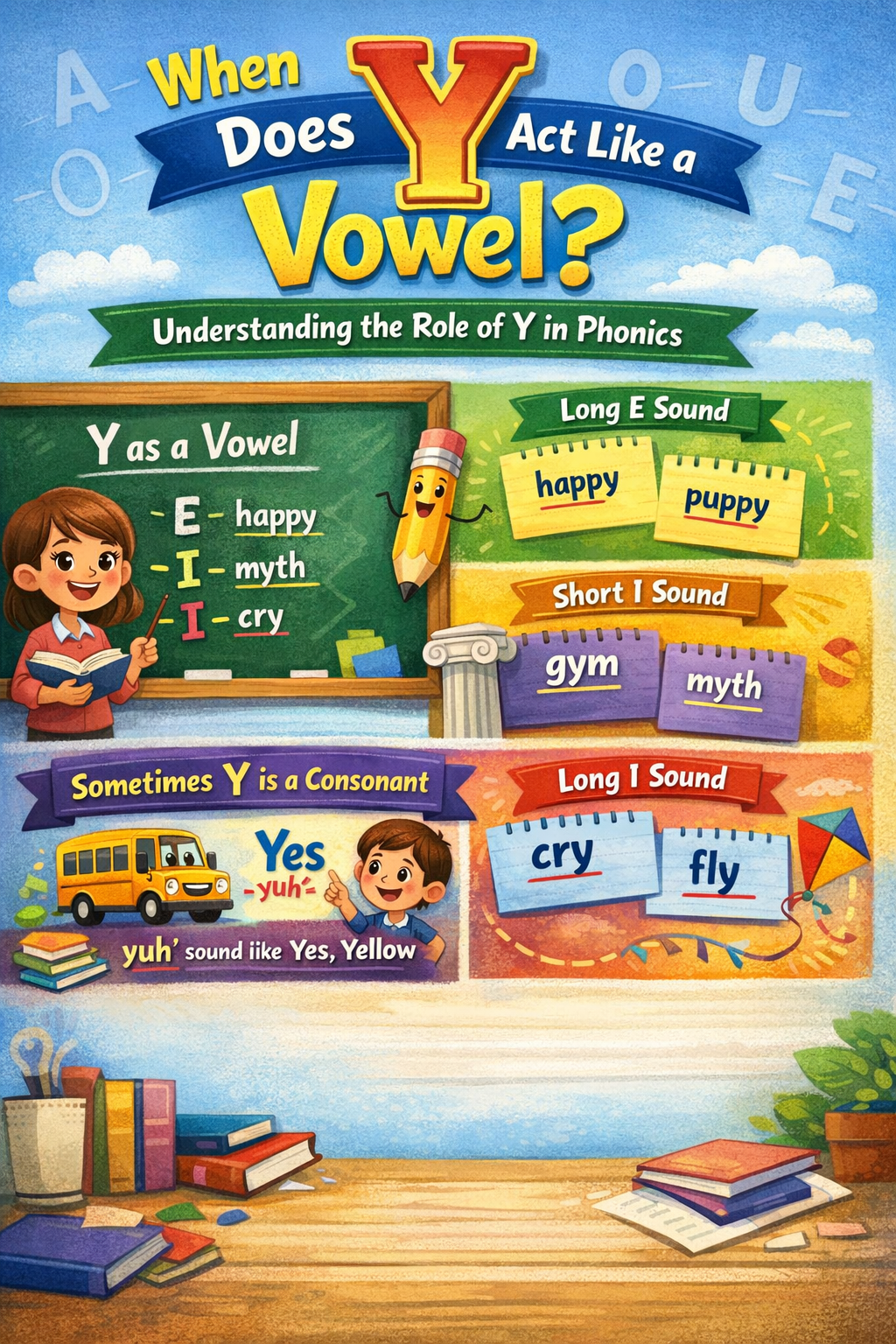
When Does Y Act Like a Vowel? Understanding the Role of Y in Phonics
The letter Y is a bit of a shape-shifter in the English language. Although it is officially classified as a consonant, it often steps into the role of a vowel, especially in certain word positions. This can create confusion for young learners which is why it is essential for teachers to explain and model these vowel sounds clearly.
To support your phonics instruction, we have created a list of words where Y functions as a vowel. In these examples, Y replaces a typical vowel and produces one of the following sounds:
- A long “e” sound, like in happy or puppy
- A short “i” sound, like in myth or gym
- A long “i” sound, like in cry or reply
By understanding how Y behaves in different contexts, students can improve their reading fluency and decoding skills with more confidence. It is also important to teach long vowel sounds as a base to students.
Cases Where Y Is a Vowel
Following is a discussion of cases where you will find y acting as a vowel
1. Y Making the Long “E” Sound (as in happy)
One of the most common cases where Y acts as a vowel is when it appears at the end of a two-syllable word and takes on the sound of a long “E.” This typically occurs in words where Y replaces the final “ee” sound. The pronunciation of Y in these words is soft and vowel-like, and it plays a critical role in completing the word phonetically.
This usage is especially common in early literacy development. Many high-frequency words that children learn in kindergarten and first grade end with Y making the long “E” sound. Recognizing this pattern helps students decode words more fluently and spell with more accuracy. You can also teach your students double consonant sounds before they learn the long e sound.
Here are some common examples of words where Y makes the long “E” sound:
- Happy
- Puppy
- Funny
- Silly
- Lucky
- Sunny
- Candy
- Tiny
- Jelly
- Breezy
- Noisy
- Grumpy
- Messy
- Busy
- Zesty
Teaching Tip:
When teaching this sound, emphasize the ending pattern “-y” in two-syllable words and pair the lesson with visuals or word families like -ppy, -nny, -lly to reinforce the pattern. Use rhyming activities to help students connect the sounds and notice the consistency of Y acting as a long “E.”
2. Y Making the Short “I” Sound (as in myth)
In certain words, especially those with Greek or Latin roots, Y can take on the sound of a short “I.” This occurs most often in one-syllable words or in unstressed syllables in longer words. In these instances, Y behaves like a vowel because it fills the role of a vowel in terms of sound and spelling.
This use of Y is common in more advanced vocabulary or subject-specific terms, making it useful for upper elementary or middle school students to recognize. Teaching students about this case expands their understanding of how flexible and dynamic English spelling patterns can be.
- Myth
- Gym
- Hymn
- Lynx
- Crypt
- Glyph
- System
- Symbol
- Syllable
- Syntax
- Rhythm
- Cylinder
- Mystery
- Typical
- Oxygen
Teaching Tip:
When introducing this sound, it helps to show how Y substitutes for a vowel where one might expect the letter I. Use syllable clapping and visual breakdowns of words to highlight the short “I” sound and identify where Y fits in the word structure. A comparison activity between “myth” and “mist” can help learners hear similar vowel sounds in different spellings.
3. Y Making the Long “I” Sound (as in shy)
Another vowel-like behavior of Y is when it sounds like a long “I.” This happens primarily in one-syllable words where Y comes at the end. The sound is identical to the long “I” found in words like cry or fly. In these cases, Y serves as the only vowel in the word and carries the full weight of the vowel sound.
Understanding this use of Y is important because it introduces students to an alternative spelling of the long “I” sound. It is especially helpful when teaching rhyming patterns, silent letters, and vowel-consonant relationships.
Word List:
- Cry
- Try
- Fly
- Sky
- Dry
- Shy
- Sly
- Spy
- Fry
- Pry
- Why
- Sty
- My
- By
- Reply
Teaching Tip:
To teach this pattern, group words by rhyming families such as -y endings that produce the long “I” sound. Use rhyming poems or short stories to reinforce sound recognition. You can also practice phoneme substitution (changing the first sound) to build more words and strengthen spelling confidence - e.g., fry, dry, cry.
Cases Where Y Is a Consonant
While Y often plays the role of a vowel, especially in the middle or end of words, it can also function as a consonant - usually at the beginning of a word or syllable. In this case, it does not carry a vowel sound but rather acts as a consonant sound similar to the "yuh" (/j/) sound, like the “y” in yes. This sound is produced by the movement of the tongue near the roof of the mouth, making it distinct from vowel sounds.
When Y functions as a consonant, it always appears at the start of a word or syllable, and it is always followed by a vowel. This positioning is a key clue for students when determining if Y is acting as a consonant.
This use of Y is commonly introduced during early reading and phonics instruction, as it is part of several high-frequency and sight words. Understanding this sound can help students decode words more effectively and recognize common word patterns.
- Yes
- Yellow
- You
- Young
- Yet
- Yell
- Yacht
- Yam
- Yard
- Yawn
- Year
- Yesterday
- Youth
- Yours
- Yummy
Teaching Tip:
To help students identify Y as a consonant, have them focus on its position in the word. If Y appears at the beginning and is immediately followed by a vowel (like yellow or yogurt), it is a consonant. Encourage sound identification games or sorting activities where students place words into vowel and consonant “Y” categories. Practicing with visuals or action words (like yell or yawn) can also reinforce recognition through movement and engagement.
How to Teach the Letter Y as a Vowel
Teaching the letter Y as a vowel can be one of the more nuanced parts of early phonics instruction. Since Y does not always behave like other vowels (a, e, i, o, u), it is important to give students both clear rules and plenty of exposure through engaging activities. Below is a step-by-step guide to help teachers effectively introduce and reinforce this concept in the classroom.
1. Start with the Concept: What Makes a Vowel?
Begin by reviewing the concept of vowels with your students. Explain that vowels are the sounds that open your mouth the most when speaking, and that every word in English needs at least one vowel sound. This concert will also help students improve speaking and listening skills. From there, introduce Y as a “sometimes vowel”; a letter that behaves like a vowel in certain situations.
You can say: “The letter Y is a little tricky. Sometimes it acts like a vowel, especially when there is not another vowel doing the job in the word."
2. Teach the Three Common Vowel Sounds of Y
Break it down into the three main sounds Y makes when used as a vowel. Teach each sound one at a time, with examples, visuals, and practice words.
a) Y as a Long “E” Sound (ee)
Appears at the end of two-syllable words
Examples: happy, puppy, candy, sunny
b) Y as a Short “I” Sound (ih)
Appears in the middle of words or unstressed syllables
Examples: myth, gym, symbol, system
c) Y as a Long “I” Sound (eye)
Appears at the end of one-syllable words
Examples: cry, try, fly, shy
Create anchor charts or posters with each sound and related word lists. Use color coding or icons to represent each vowel sound visually.
3. Use Word Sorting Activities
Give students a mix of words with Y as a vowel and Y as a consonant. Ask them to sort the words into categories based on the sound Y is making (long E, long I, short I). This builds pattern recognition and supports phonemic awareness.
4. Integrate Reading and Spelling Practice
Include books, poems, or short passages that contain Y as a vowel. Highlight or underline the Y in each word and discuss what sound it makes. Ask comprehension questions like:
- Is the Y making a vowel sound here?
- Which vowel sound is it: long E, short I, or long I?
Then move to spelling. Use dictation or interactive whiteboard activities to reinforce spelling patterns of words ending in -y and those using Y in the middle.
5. Reinforce with Creative Activities
Here are a few fun ideas to help solidify the concept:
- Y Sound Scavenger Hunt: Let students find objects or pictures with words that contain Y as a vowel.
- Rhyming Wheels: Create spinning rhyming tools with endings like -y (cry, fly, shy) to build fluency.
- Y Flipbooks: Have students create a mini-book for each Y vowel sound with drawings and word examples.
6. Review and Revisit Regularly
Because Y has multiple roles, regular review is essential. Revisit the different Y sounds during weekly phonics practice or warm-up activities. Use exit tickets or short assessments where students identify what role Y plays in a set of words.
Worksheet Ideas: Teaching Y as a Vowel
Following are some worksheet ideas to teach students y as a vowel.
1. Y Word Sort Worksheet
Help students distinguish between words where Y is a vowel and where Y is a consonant.
Instructions:
- Provide a mixed list of 20–25 words (e.g., yes, happy, fly, myth, yellow, gym).
- Create two columns: “Y as a Vowel” and “Y as a Consonant.”
- Students cut and paste or write the words into the correct column.
2. Color Code the Y Worksheet
Practice identifying different sounds of Y in context.
Instructions:
- Provide 10–15 short sentences containing words with Y.
- Students use different colors to highlight: Blue for Y as a consonant, Green for long E sound, Yellow for short I sound, Red for long I sound
3. Complete the Word: Y or Not Y?
Practice identifying when to use Y to complete a word and understand its vowel function.
Instructions:
- Provide fill-in-the-blank words with missing Y, like: cr_, happ_, s_mbol
- Students fill in the blanks and decide if Y is a vowel or consonant in each case.
Common Mistakes Students Make with the Letter Y
Understanding the dual nature of the letter Y can be confusing for young learners. Since Y can act as both a vowel and a consonant and produce different vowel sounds; students often mix up how it should sound or be classified. Below are some of the most common mistakes students make, along with helpful strategies for correcting them in the classroom.
Assuming Y Is Always a Consonant
Many students learn early on that Y is a consonant (as in yes or yellow), and they tend to carry that assumption to every word. This can lead to confusion when decoding or spelling words like cry or funny, where Y actually functions as a vowel.
Teaching Tip: Use anchor charts or visual aids showing examples of Y acting as both a vowel and a consonant. Reinforce the idea that its position in the word determines its role.
Mixing Up the Vowel Sounds of Y
Because Y can make three different vowel sounds; long E, short I, and long I, students often confuse them. For example, they might pronounce myth with a long I or say happy with the wrong ending vowel sound.
Teaching Tip: Break down each vowel sound Y can make and give students word families to practice. Color coding the different Y sounds (e.g., red for long I, green for long E) can also help build sound recognition.
Misplacing Y in Spelling
Students may try to use Y incorrectly in spelling words, especially when they are unsure of whether the sound should be represented with a Y, I, or E. For instance, spelling candy as candi or sky as ski.
Teaching Tip: Focus on visual spelling patterns and play games where students identify the correct spelling of Y words from multiple choices. Include frequent exposure to high-frequency Y-words in writing activities.
Thinking Y Cannot Be the Only Vowel
Students often believe every word must have one of the five main vowels (A, E, I, O, U). So when they see words like my, cry, or gym, they may incorrectly assume the word is misspelled or incomplete.
Teaching Tip: Introduce the concept of Y as a vowel substitute, especially when it is the only letter making a vowel sound in the word. Reinforce this with phonics games, clapping syllables, and identifying vowel sounds together as a class.
Misidentifying Y in Multisyllabic Words
In longer words like typical, mystery, or system, students may struggle to pinpoint the vowel role of Y, especially when it is found in unstressed syllables or the middle of the word.
Teaching Tip: Teach syllable division and stress patterns. Have students break words into syllables and identify the vowels in each. Emphasize that Y often appears in the middle of multisyllabic words making the short I sound.
Conclusion
The letter Y may be small, but it plays a big role in phonics and word recognition. As we have explored throughout this blog, Y can function as both a consonant and a vowel, taking on different sounds depending on its position in a word. For teachers, understanding and clearly explaining these roles is key to helping students build strong decoding, spelling, and reading skills.